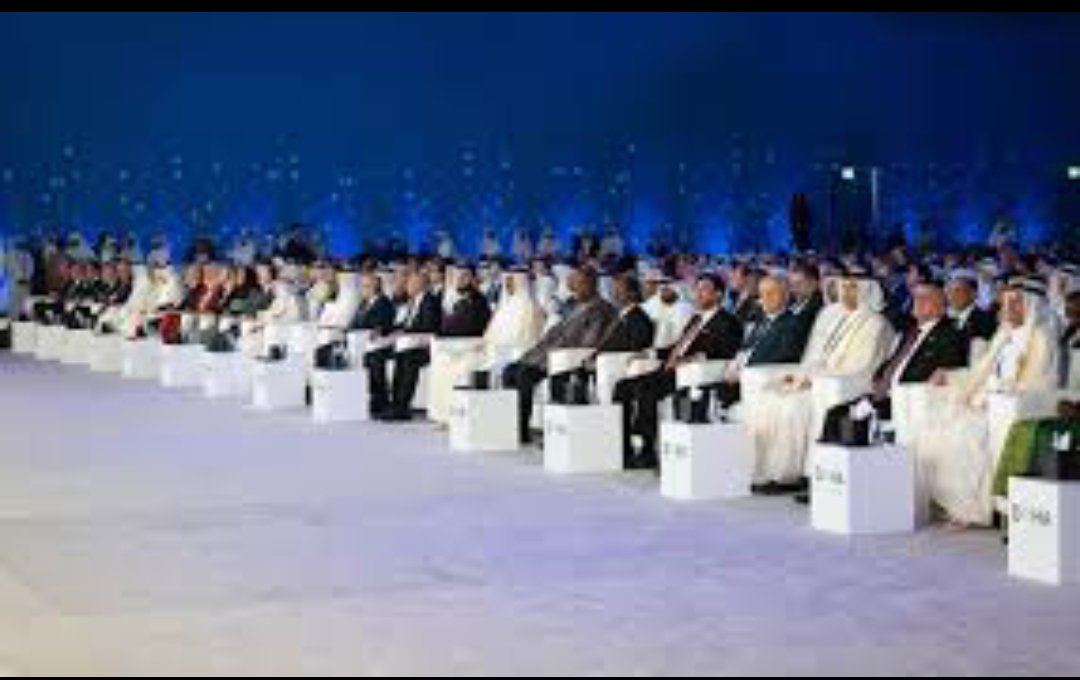

The Doha Forum, held on 6 and 7 December 2025 in the Qatari capital, brings together heads of state, senior government officials, academic experts, representatives of international organizations and members of civil society. The 2025 edition, organised under the theme Justice in Action: Beyond Promises to Progress, focuses on global governance, regional stability, international justice and the emerging challenges reshaping the world order. As the second and final day unfolds today, discussions continue to reflect the urgency and complexity of the international moment.
The opening session was presided over by the Amir of Qatar, Sheikh Tamim bin Hamad Al Thani, who called for a transition from commitments to concrete action. His remarks set the tone for high-level interventions that described an international landscape marked by the multiplication of crises, eroding trust among global actors and the growing gap between political declarations and effective implementation. Qatar’s Prime Minister and Minister of Foreign Affairs, Sheikh Mohammed bin Abdulrahman Al Thani, stressed that lasting peace depends on efficient international mechanisms and clearly defined responsibilities capable of responding to systemic global risks.
The situation in the Gaza Strip has dominated a significant part of the exchanges. Qatari authorities reiterated that the current truce cannot be considered a durable ceasefire, pointing to limited humanitarian access, severe restrictions on civilian movement and military operations that are only partially suspended. Doha outlined the mediation framework it continues to lead, centred on a phased release of detainees, the formation of an interim Palestinian government, the potential deployment of an international security force and the establishment of continuous humanitarian access. Delegations from across the Middle East added their own perspectives, illustrating the diversity of regional positions on the Israeli–Palestinian conflict and its broader implications.
International justice has also emerged as a consistent focus of the Forum. A number of delegations called for meaningful reforms of multilateral institutions and for more robust accountability mechanisms. Participants from Europe, Africa and Asia insisted on the necessity of coherent legal standards applied uniformly, regardless of geographic or political context. Bosnia and Herzegovina invoked its historical experience to underline the importance of international judicial systems capable of addressing the gravest violations of international law.
The Forum has further highlighted long-term structural pressures that threaten global stability. Pakistan’s Minister of Planning identified demographic expansion and climate stress as major risk factors requiring coordinated global action. He argued for strengthened financial support to the most vulnerable states and for development models that integrate climate adaptation, economic resilience and sustainability as core priorities.
As discussions continue into the second day, the Doha Forum has reaffirmed Qatar’s role as an international hub for dialogue and diplomacy. The meeting has provided a platform to showcase the country’s mediation efforts in several regional crises and its commitment to advancing multilateral cooperation. Alongside political deliberations, the Forum has hosted technical exchanges on economic governance, institutional reform, security cooperation and climate commitments.
Although the Forum is not expected to produce binding resolutions, the debates of the past two days have helped clarify the priorities of many institutional actors. Emerging orientations include strengthened coordination for ongoing mediation processes, proposals for reforming multilateral frameworks, renewed calls for effective international cooperation and avenues for supporting nations most exposed to climate-related shocks. In a moment of profound geopolitical uncertainty, the Doha Forum has underscored a central message: justice, stability and good governance cannot remain aspirational ideals but must translate into collective, operational action.